
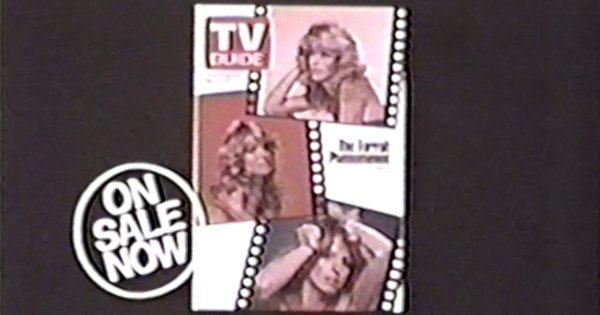
Launched in 1953, TV Guide magazine was once essential reading for tens of millions of TV viewers every week. Relive the glory days of TV Guide by watching an assortment of commercials, broadcast on local stations during the 1960s, 1970s and 1980s.
A Brief History of TV Guide
In the early 1940s, when broadcast television was still young, television stations mailed out weekly programming schedules on cards to the limited number of households owning television sets. Television listings were also often found in newspapers. By the late 1940s, many larger markets saw the development of magazines devoted exclusively to television listings, including TV Guide in New York City, TV Forecast in Chicago and TV Digest in Philadelphia. In April 1953, Triangle Publications launched a national TV Guide magazine after buying the three aforementioned local magazines and at least six others [1], [2].
The inaugural issue of TV Guide was published on April 3rd, 1953. On the cover was Desi Arnez, Jr., newborn son of popular television personalities Lucy and Desi Arnez. During the first six months of 1954, TV Guide was selling an average of 1.6 million copies per issue on the newsstands (not counting subscriptions) [3]. Despite this success, in March 1955 there were still roughly 80 other television magazines being published, excluding the 31 local editions of TV Guide [4].
Still, the national TV Guide grew yearly. The December 31st, 1955 issue sold 3.8 million copies (in 38 editions); roughly one million issues were sold in the New York metropolitan area alone [5]. By 1960, TV Guide was selling over seven million copies per issue [6].
Advertising on Television
As a magazine catering to the television industry, it should come as no surprise that eventually TV Guide would turn to television for advertising. The magazine began striking bargains with local stations whereby TV Guide would advertise the local station in its magazine and the local station would give the magazine free airtime [7].
By 1967, TV Guide was bartering roughly $4 million worth of advertising space within its pages (it had a circulation of 12.5 million at that time) in return for local airtime [8]. A decade later, now selling some 20 million issues a week, TV Guide used over $11 million worth of advertising time for free and was printing advertisements for local stations in roughly 100 local editions [9].
Here’s an example of the voice over used to promote the June 26th-July 2nd, 1976 issue:
This week TV Guide takes camera in hand to cover Mary Tyler Moore’s mission to Moscow. She headed east to tape a show celebrating the renowned Bolshoi Ballet’s own bicentennial. The story, in words and pictures, in TV Guide magazine.”
By the late 1970s, the annual “fall preview” issue was not only TV Guide‘s biggest-selling issue, it was the single biggest-selling issue of any magazine in the United States. The 1976 “fall preview” issue sold 21,434,170 copies; the 1978 version 21,542,649 copies (by comparison, the worst-selling issue in 1978 was the July 4th issue, which sold a lowly 18,663,496 copies) [10], 11].
The TV Guide Empire Begins to Crumble
During the 1980s, the rising popularity of cable television began to threaten TV Guide‘s dominance. When Rupert Murdoch’s News Corporation agreed to buy TV Guide in 1988, circulation was down to roughly 17 million [12].
Listing the programs shown on broadcast television during the 1960s and 1970s was one thing, but with tens of millions of households wired for cable — and dozens of cable systems operating nationwide — competitors to TV Guide such as The Cable Guide began popping up, focusing solely on cable systems [13]. In September 1989, in an effort to boost circulation, TV Guide spent $10 million on an ad campaign featuring 30-second commercials to air for five weeks on the broadcast networks, including FOX, plus local stations and cable television [14]. More spots were aired in 1990 and 1992 [15], [16].
No amount of television advertising could stem the tide of dropping circulation, however. When News Corporation sold TV Guide in 1998, circulation had fallen to 13.1 million [17]. In October 2005, TV Guide relaunched as a full-size magazine. Circulation rose to 4.9 million, outpacing expectations [18]. In December 2007, Macrovision purchased TV Guide from current owner Gemstar-TV Guide International. At the time, circulation had fallen to 3.3 million [19].
Soon after acquiring TV Guide, Macrovision began selling pieces off bit by bit. OpenGate Capital purchased the magazine in October 2008 for $1 [20]. When OpenGate Capital sold the magazine to NTVB Media in October 2015, circulation was roughly 1.8 million [21].
Works Cited:
2 “News in the Advertising and Marketing Fields.” New York Times. 26 Oct. 1954: 45.
3 Ibid.
4 Smee, Doyle. “TV Offshoot.” Wall Street Journal. 15 Mar. 1955: 1.
5 “News of Advertising and Marketing.” New York Times. 9 Jan. 1956: 35.
6 “TV Guide Circulation Up.” Wall Street Journal. 2.
7 Kandel, Myron. “Advertising: TV Guide Cancels Toy Section.” New York Times. 31 Jul. 1962: 32.
8 MacDougall, A. Kent. “A Magazine Prospers By Mixing TV Listings With ‘Inside’ Articles.” Wall Street Journal. 13 Jun. 1967: 1.
9 “News Behind the Ads.” Changing Times. 1 May 1977: 5.
10 Turan, Kenneth. “Some Winners . . . A Loser; Best-Selling Magazine Covers of 1976.” Washington Post. 1 Feb. 1977: B1.
11 Zito, Tom. “Look’s New Look Is Like Life Itself.” Washington Post. 6 Feb. 1979: B1.
12 Gerard, Jeremy. “TV Guide’s Power Over the Air.” New York Times. 11 Aug. 1988: D1.
13 Landro, Laura and Johnnie L. Roberts. “Rivals Seek to Chip Away at TV Guide’s Dominance.” Wall Street Journal. 12 Aug. 1988: 15.
14 Reilly, Patrick M. “TV Guide Starts Advertising Drive Costing $10 Million.” Wall Street Journal. 5 Sep. 1989: B4.
15 Lippert, Barbara. “Tuned in TV Guide discovers a smart new way to sell print on television.” Chicago Tribune. 30 Apr. 1990: 2.
16 Stuart, Elliott. “A TV Set Helps Promote TV Guide.” New York Times. 21 Aug. 1992: D.15.
17 Fabrikant, Geraldine. “Murdoch Sets TV Guide Sale for $2 Billion.” New York Times. 12 Jun. 1998: D1.
18 “Gemstar-TV Guide International: New Version of Magazine Lifts Newsstand Sales, Circulation.” Wall Street Journal. 12 Jan. 2006: 1.
19 Liedtke, Michael. “TV Guide’s future full of static after $2.8B deal with Macrovision.” Associated Press Financial Wire. 7 Dec. 2007.
20 Hayes, Dade. “Macrovision finally gets rid of TV Guide.” Daily Variety. 14 Oct. 2008: 3.
21 Spangler, Todd. “TV Guide Magazine Sold to Publishing Firm NTVB.” Variety. 7 Oct. 2015.
Originally Published August 20th, 2003
Last Updated August 6th, 2015


I was curious as to the announcer on those TV Guide spots from the 1960’s up to early 1981 (he remained in place for a short while after that “spacey” background music was finally retired). Probably a veteran Philadelphia radio-TV personality?
Also . . . the Sandy Duncan cover story was from the Sept. 18-24, 1971 issue.
Thanks for the correction, W.B.
Also . . . from the early 1960’s to 1981, the “Voice of TV Guide” was longtime Philadelphia radio and TV broadcaster, commentator and news analyst Taylor Grant.
I have that 1985 issue of TV Guide as seen in that last spot! :)
I have over 600 TV guides from the 60s all the way up to 2007, people magazines from back in the 80s, Time Life magazines from back in the 80s Star Trek magazines and so much more we’re talking about at least around 700 vintage magazines and TV guides where can I go or is there anybody that I could find that would buy all this stuff I have boxes and boxes and boxes. The lady I inherited this from made her living selling this stuff but there’s just so many problems me trying to sell it on eBay with all their insertion fees and everything else can someone help me please I’m really willing to get rid of them for a small price but I’m not going to sell them as a steal
Where would one began to look for copies of TV Guide for purchase and put with your collectables?
i remember as a teenager never being able to get my hands on TV guide fast enough. aside from Archie comics, it was my favorite magazine – couldn’t get enough of it. but like everything, it too went by the way side. just like good television has.
I remember eagerly waiting for Mom to come home from the store after doing the weekly shopping with the new TV Guide when I was a kid. It was always sad to look through the listings and see the words [Last Show of the Series] when a program had been cancelled and was airing its last episode.
Then, when I was on my own, I actually subscribed to the magazine. It was great reading.
I have a stack of TV Guides in my guest room closet — probably 40 of them, featuring every in-depth article about “Murder, She Wrote” and many of the promotional ads that ran promoting the series at the start of various seasons during its network run.
I do remember from the old TV Guide magazine commercials from the 1970s that that background sound in these commercials that had a sound similar to an alien spaceship that lasted from 1970 to 1979
I remember the old TV Guide magazine commercials on TV from 1971 to 1980 that had a background sound that was very similar to an alien spaceship.
I do remember the old TV guide commercials
I do remember the old TV Guide magazine commercials from 1971 to 1980, which its background sound was very similar to an alien spaceship
Who was the voice over the tv guide commercial in 19757
I have a TV Guide collection going back to 1948 and a complete run of issues from 1949 to 1956.
It is fascinating to trace the history of television and its’ programming from the early days to the present.