
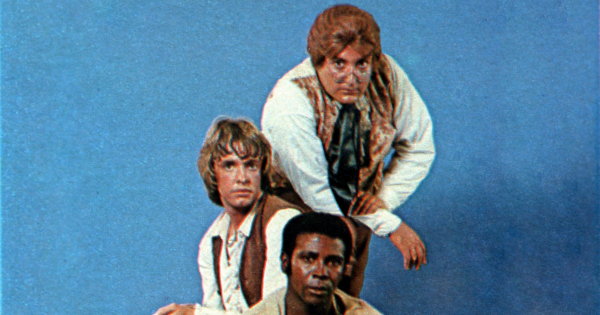
The Young Rebels ran for just 15 episodes on ABC during the 1970-1971 season, part of a wave of relevant network TV shows aimed at young viewers. Set during the Revolutionary War, the show followed the adventures of four youngsters in the Colonies fighting for independence.
Television Turns To Relevance
When CBS and NBC unveiled their 1970-1971 schedules on February 19th, 1970, relevance was the word of the day. Michael Dann, head of programming for CBS, promised shows “dealing with the now scene” while Mort Werner, programming chief for NBC, called the upcoming season “relevant, contemporary and real” [1]. ABC at the time had yet to reveal its schedule but programming head Martin Starger did promise “less and less of pure silly escape and more and more reality” [2]. When the network did release its schedule on February 26th, it included not one but two new programs whose included the word “young” in them [3].
One was The Young Lawyers and the other The Young Rebels. The former was quite obviously about youthful attorneys but the latter needed some explanation. It was to be set during the Revolutionary War and therefore would feature youthful patriots opposing British Rule of the American Colonies. It would fill the 7-8PM time slot on Sundays, replacing Land of the Giants which was cancelled after two seasons. A two-page advertisement in the March 30th, 1970 edition of Broadcasting laid out the network’s vision for the upcoming season:
Starting this fall, these men will be getting into it, helping people out of it, stopping it and even starting it. And they’ll be doing it all on ABC Television, in seven exciting new dramatic series. All designed for today’s changing audience demands.
[…]
And Sundays Rick Ely will be leading “The Young Rebels,” a trio of underground patriots fighting for American independence in 1777.
What does all this mean in the marketplace? It means adults under fifty. Our prime success. And your prime target. In short, it means we’ve designed our fall schedule to entertain this desirable audience and meet your advertising needs. If you’re looking around for the best way to reach your prime customers, look to ABC… we’re to be watched. [4]
(Similar advertisements focusing on comedies and TvQ measurements were published in the March 16th and April 6th issues, respectively.)
At a Los Angeles affiliates meeting in mid-May, ABC laid out its strategy for fall. The Young Rebels was called an “exciting, colorful, wholesome hour for parents and children alike” that, thanks to a “family-audience compatibility” with The FBI, offered the best opportunity in years for the network to get Sunday off to a strong start [5]. An Associated Press article published in mid-August noted that the networks were continuing to focus on the 18-35 demographic and suggested that the success of ABC’s The Mod Squad (which had premiered in September of 1968) spawned a number of “Now dramas” in the upcoming season, including The Young Rebels, The Interns, The Young Lawyers and The Storefront Lawyers [6]. Joining these shows were the “Now sitcoms” which included Nancy, Barefoot in the Park and The Headmaster.
A Young, Diverse Cast
In early May, Broadcasting reported that Rick Ely, Alex Henteloff and Lou Gossett had been signed to star in The Young Rebels [7]. They all qualified as young: Ely was 25, Henteloff 28 and Gossett 34. The three would portray members of the Yankee Doodle Society, a secret guerrilla movement operating out of Chester, Pennsylvania. Ely played Jeremy Larkin, leader of the Yankee Doodle Society, whose public persona was that of a fairly inept, lackadaisical youth and the perfect cover. Jeremy’s father, played by Will Geer in a number of episodes, was mayor of Chester and a Loyalist. Henteloff portrayed Henry Abington, the Society’s brilliant tinkerer who designed explosives and other devices to help fight the Red Coats. Gossett played Isak Poole, a former slave trained a blacksmith who purchased his own freedom and joined the fight against the British.

Copyright © TV Guide, 1970[1]
Rounding out the cast was 21-year-old Hilarie Thompson as Elizabeth Coates, Jeremy’s girlfriend whose feminine innocence allowed the Society more freedom than it might otherwise have. Elizabeth’s uncle, who was her guardian, disapproved of her relationship with Jeremy. Like Thompson, Philippe Forquet appeared regularly, but not in every episode, as General Lafayette, who the Society encountered in the series premiere.
Gossett, in an August 1970 article in The New York Times, suggested that “Rick Ely’s long-haired rebel image is done quite deliberately for people who frown on long hair per se, to remind them that our first young revolutionaries–Lafayette, Nathan Hale, Aaron Burr–were only 19 and 20 years old. They were babies and they had the full responsibility for writing the Declaration of Independence” [8]. He called Isak Poole “an opportunity to portray a great deal of strength” with “an image that is not derogatory for Black people–which I’m concerned about” [9]. Of the series overall, Gossett felt The Young Rebels was “trying to be as truthful as possible on TV without losing our audience. It’s a noble kind of TV series, but we don’t get too schmaltzy about it. We show the ugliness of war and the weariness of soldiers” [10].
Similarly, in an August 1970 Associated Press article, Ely admitted that historical liberties had been taken but argued “our scripts are more concerned with the philosophy of the revolution and the moral wrongs that were committed” [11]. To address the historical aspects of the series, each episode ended with voice over, reading aloud text that scrolled on the screen. The text explained what happened due to the events that took place in that episode. For example, young British soldiers who were impressed with the young rebels would return to England changed men. Additionally, at the end of each episode’s closing credits appeared the following disclaimer: “Some of the dates, events, and people in this episode were fictional.”
Predictable Plots
The series premiere opened in the immediate aftermath of the Battle of Brandywine, which took place in September of 1777. The battle was a loss for the Americans and during the ensuing retreat Lafayette was wounded. It was during this retreat that Lafayette met the Yankee Doodle Society. Jeremy’s older brother, Robert (played by Frank Converse), also fought in the battle and had no idea that his brother was secretly a guerrilla. Jeremy and the others devised a plan to recover a number of canon captured by the British. Lafayette commissioned Jeremy as a captain in the Continental Army. Although the canon were recovered, tragically Robert was killed in the process. Lafayette, impressed by the Society, began assigning them missions only they could carry out.
I really love your site and particularly about Young Rebels as I really loved that show.”
Katie
There was very little actual violence perpetrated by the Society, who preferred subterfuge and sabotage. They would propagandize, intercept orders, spread disinformation and otherwise disrupt the movement of British troopers. At their most successful, the group would destroy cannons or ammunition caches. Because Chester was under British control, there was no shortage of opportunities and targets, but episodes also took place elsewhere, including Williamsburg, Philadelphia and Valley Forge. Given the setting and role of the characters, plots were about what would expected. There were episodes in which a character was wounded and in dire need of medical attention or captured and in dire need of rescuing or had to pretend to be a Loyalist in order to obtain information. Isak fared worse than the others; he was both wounded and captured (in separate episodes).
Family members occasionally got in the way. In one episode Isak was shocked to learn that his brother, a runaway slave, had become an informant. In another, Henry’s cousin’s determination to strike at the British without any concern for civilian casualties leads to Henry being captured by the British and sentenced to death. Elizabeth’s role was often to provide cover or an air of respectability. In the premiere, for example, she and Jeremy are able to hide Lafeyette and others by kissing in a barn, outraging her uncle and amusing the British soldiers.

Rick Ely as Jeremy Larkin
Episodes saw the Society trying to keep the British from melting down a bell to make cannons, attempting to stop an assassin from reaching George Washington without realizing he’s infiltrated their group, learning that an old friend of Robert’s has become a double agent working for the British rather than against them, forced to work with a group of British soldiers after they are all trapped in a mine shaft following a cave-in, and charged with rescuing Nathan Hale, who has been captured and is far behind enemy lines.
Aside from General Lafayette and Nathan Hale, at least one other true-to-life historical figure appeared in The Young Rebels, albeit a little known one. Monte Markham guest starred in the November 29th, 1970 episode as composer William Billings. In the episode, his patriotic compositions offend the British. He is arrested and given the “opportunity” to recant. Instead, he helps Jeremy and the Society destroy a number of cannon protecting a nearby valley. He then reveals that he has altered the lyrics to one of his songs:
The foe comes on with haughty stride
Our troops advance with martial noise
Their veterans flee before our youth
And generals yield to beardless Boys
The title of the song? “Chester,” named by Elizabeth after the home of the Yankee Doodle Society. Billings and the song really existed, although while it may have been written with some young rebels in mind, it obviously wasn’t really named to commemorate the deeds of The Young Rebels.
A total of 15 episodes were broadcast, the last of which was seen on January 3rd, 1971. Over the course of the episodes guest stars included John Colicos, David Soul, Larry Linville, Paul Winfield and Farrah Fawcett.
Lukewarm Reviews…
Reviews of The Young Rebels were either hostile or indifferent. Broadcasting, in reviewing the reviews, suggested that “the week’s booby prizes” went to Nancy on NBC, The Interns on CBS and The Young Rebels on ABC [12]. Jack Gould’s brief review in The New York Times stated simply that it was set in the 1770s rather than the 1970s, reminding viewers of ABC’s ploy to connect the contemporary rebellious youth with the historical, and that it “has the normal appeal of underground forces surreptitiously helping the good guys” [13]. Norman Mark of the Chicago Daily News had perhaps the most vicious review, calling the series “a despicable show” and insisting that the “executives at ABC must have spent long hours creating as silly, as stupid and as needlessly violent a program as this one” [14].
Ron Powers of the Chicago Sun-Times called out the network: “Clever gambit, ABC. Trying to co-opt the activist young by depicting them as the ones who made this country what it is. I’ve seen more authentic dialogue on the menu of the Old English Room of the Pearson Hotel.” And the New York Post‘s Bob Williams, although conceding that it was “a bang-bang case of…adventure exploitation,” felt the series was “utterly without meaning for the customary young customers of Lassie.”

Lou Gossett as Isak Poole
Lawrence Laurent of the Washington Post was more ambivalent, writing that the series “isn’t bad enough to condemn and it isn’t good enough to praise. That makes it a most typical television series for the young.” A kinder review came from Ben Gross of the New York Daily News, who felt the series “should appeal to the youngsters and also to some adults. For it is essentially a Western in colonial costume, with the British replacing the Indians.” By comparison, Cecil Smith of the Los Angeles Times was practically effusive with his praise: “Don’t get the idea it’s kiddie stuff–it’s worth watching whatever your age.”
…And Low Ratings
CBS and NBC began unveiling the new and returning shows on Sunday, September 13th. ABC, however, didn’t start rolling out its slate of new and returning programs until Sunday, September 20th. The Young Rebels was the very first program, new or returning, to premiere. Based solely on New York City overnight Nielsen ratings, it ranked third from 7:30-8PM where it faced the season premiere of Hogan’s Heroes on CBS and the first half of The Wonderful World of Disney on NBC (which had its season premiere the previous week) [15]. When final national Nielsen ratings for the week of September 14th were released, the premiere was outside the Top 40. However, The ABC Sunday Night Movie, which followed The Young Rebels, ranked 21st and on its strength the network won Sunday night [16]. The September 27th episode also ranked third in its time slot [17].
Ratings for the series never improved and on November 13th when ABC unveiled its mid-season changes, The Young Rebels had been cancelled [18]. Rather than replace it, the network decided to return the 7-8PM hour on Sunday evenings to its affiliates. Overall, ABC would return three prime time hours to its affiliates by cancelling six programs, including Silent Force, Matt Lincoln, The Immortal and Most Deadly Game. A seventh, This Is Tom Jones, was cut back to airing once a month. The move to return so much time to stations was made due to a recent FCC decision forcing the networks to return an hour of prime time to affiliates by the start of the 1971-1972 season. At the time of the announcement, ABC had nine of the bottom 12 programs in the most recent Nielsen report; The Young Rebels was among them [19].

Hilarie Thompson as Elizabeth Coates
In April of 1970, Herb Jacobs of TV Stations Inc. predicted that The Young Rebels would average a 28 share of the audience from 7-8PM, with Lassie on CBS drawing a 31 share and Hogan’s Heroes a 30 share (for an average 30 share) while NBC would get a 27 share from 7-7:30PM with Wild Kingdom and a 37 share for the first half-hour of The Wonderful World of Disney (for a 32 share). Jacobs, who referred to The Young Rebels as a “200-year-old version of Mod Squad,” had an accuracy rate of 81-97% the previous season, depending on the margin of error used [20].
Based on national Nielsen ratings through November 8th, covering the first eight episodes of the series, The Young Rebels averaged a 12.7 rating and a 23 share [21]. Out of the 22 new programs on all three networks, it was tied with The Tim Conway Show on CBS in terms of rating and 13th (again with The Tim Conway Show) in terms of share. Out of just the 12 new ABC programs it ranked seventh based on rating and fourth based on share. Only Monday Night Football, The Partridge Family and The Danny Thomas Show drew higher shares.
However, it fared poorly compared to The FBI and The ABC Sunday Night Movie (both of which ranked in the Top 30 for the 1970-1971 season) and was thus the easiest hour for the network to give up on Sundays. Plus, the network’s returning programs on average performed much better than the previous season, meaning there were few time slots open to shift under performing new programs. Had the series done better in the ratings and if ABC had not been planning for the loss of so many prime time hours the following season, it is possible the network could have moved it to another night where it might fare better. But that didn’t happen.
Revolutionary Relevancy Fails to Catch On
The series quite obviously attempted to draw parallels between the radical youth of 1960s America with the young men who took up arms against the British during the Revolutionary War. The long hair Rick Ely sported in the series, as Lou Gossett noted, poked fun at those who looked down on “dirty, long-haired hippies.” In many respects, the series was little more than The Mod Squad meets The Wild Wild West though neither as counterculture as the former nor as violent as the later. Being scheduled in the 7-8PM Sunday time slot meant keeping violence to a minimum. ABC’s description of the series as wholesome, and the fact that repeats wound up on the Christian Broadcasting Network, gives a pretty good indication of intended tone and desired audience. Younger viewers may have tuned, perhaps even in large numbers, but the overall ratings picture was bleak.
The larger trend towards relevancy taken by the 1970-1971 season was likewise mostly a failure. George Gent, in an early September 1970 article in The New York Times, pointed out that the relevancy was little more than traditional characters “dripping with social consciousness” [22]. Roughly a month after the 1970-1971 season had begun, UPI’s Rick Du Brow wrote “no television trend in recent memory has bombed out as fast the current one in which news [sic] series were advertised as emphasizing social relevance” [23]. He called the rush to relevancy “monumental misjudgement” of two facts: “that network television has a basically middle aged-to-older, middle class, conservative audience, and always will have so long as programming is constructed for mass viewership; and that young persons, who are entirely aware of this fact, simply do not go to television for relevance.”

Philippe Forquet as General Lafayette
Norman Dresser of the Toledo Blade suggested that “viewers have not rejected relevancy” but “phony relevancy, bad scripts, and just plain boring programs” [24]. The Young Rebels failed because it was “just another lousy action drama.” Hilarie Thomson, in Tom Lisanti’s Drive-In Dream Girls: A Galaxy of B-Movie Starlets of the Sixties, discussed the quick demise of the series:
This was an interesting failure. We filmed right next door to The Partridge Family, which started the same year. Both shows were aimed at the teenage audience. Somehow that show connected and we didn’t. If I were guessing why, I’d say it was because of the actors. I believe that the television audience watches a particular show because they want to spend time with the people. They just didn’t catch on to us particularly–not that I took it as a personal affront. It was the show’s whole chemistry. But I could be wrong. Maybe it was the whole Revolutionary War setting. The audience went, “huh?” [26].
Perhaps what doomed the series was its attempt to fit too many categories: action-adventure, historical fiction, comedy, romance. series suffered from too many. It may have worked as just an action-adventure series if that was all it was. And the historical setting could have worked, too, if not for the relevancy angle and Rick Ely’s hair. The humor, too, if not overdone. That leaves the romance between Jeremy and Elizabeth. It felt wildly out of place as if keeping Elizabeth around was nothing more than an attempt to include the token female who tended to the wounded and allowed British soldiers to argue that they don’t wage war on little girls.
Regardless of why it failed, it did. But despite lasting just 15 episodes, the series spawned two novels (written by prolific TV tie-in author William Johnston) and a single Dell comic book.
Works Cited:
2 Ibid.
3 “ABC fits its final pieces into jigsaw.” Broadcasting. 2 Mar. 1970: 20.
4 [Advertisement]. Broadcasting. 30 Mar. 1970: 78-79.
5 “How ABC views the fall season.” Broadcasting. 18 May 1970: 52.
6 “Hollywood Churning Out 107 Shows.” Associated Press. Hartford Courant. 16 Aug. 1970: 3L.
7 “Program notes.” Broadcasting. 4 May 1970: 37.
8 Stone, Judy. “Lou Gossett: ‘Did We Always Eat Watermelon?’.” New York Times. 30 Aug. 1970: D18.
9 Ibid.
10 Ibid.
11 Lowry, Cynthia. “ABC ‘Young Rebels’ Takes Liberties with U.S. History.” Associated Press. Press-Courier [Oxnard, CA]. 11 Aug. 1970: 11.
12 “Better reviews for latest shows.” Broadcasting. 28 Sep. 1970: 44.
13 Gould, Jack. “TV Review.” New York Times. 21 Sep. 1970: 87.
14 All further review segments were excerpted in the September 28th, 1970 edition of Broadcasting (“Better reviews for latest shows,” Page 45).
15 “ABC strong in first New York ratings.” Broadcasting. 28 Sep. 1970: 46.
16 “CBS beats NBC in premiere week.” Broadcasting. 5 Oct. 1970: 57-58.
17 “Nielsen, Arbitron differ on ratings.” Broadcasting. 5 Oct. 1970: 59.
18 “Ferretti, Fred. “A.B.C. Revamps Network TV Lineup.” New York Times. 14 Nov. 1970: 35.
19 “Networks at work on casualty lists.” Broadcasting. 16 Nov. 1970: 54.
20 “A forecast of TV’s ’70 fall season.” Broadcasting. 13 Apr. 1970: 60-61.
21 “A midpoint recap of the TV season.” Broadcasting. 21 Dec. 1970: 44.
22 Gent, George. “TV Will Drip Social Significance.” New York Times. 7 Sep. 1970: 37.
23 Du Brow, Rick. “Relevance Bombs Out.” United Press International. Modesto Bee. 15 Oct. 1970: 9.
24 Dresser, Norman. “Is it ‘Relevant’ or Just Sensational?” Toledo Bee. 9 Nov. 1970: 40.
25 Lisanti, Tom. Drive-In Dream Girls: A Galaxy of B-Movie Starlets of the Sixties. Jefferson, NC: McFarland & Company, Inc., 167-168.
Image Credits:
Originally February 15th, 2005
Last Updated April 22nd, 2018


I was a big fan of this show when I was a child. But never saw or heard of it since 1970. And then today, my random memory brought it back to me so I decided to google it and see if it was real or a figment of my imagination.
I am know what you mean. I used to love the show and looked forward to watching it. I also had the biggest crush on Rick Ely. Today I was wondering whatever happened to him. So I just pulled up Google and read about the show that I haven’t seen in years.
Well. I think I was in the 7th grade. Haven’t done the math. After hearing it would be cancelled, I started a petition at my school to keep this show on the air, claiming it was very relevant to our nations’ history and we were approaching the bicentennial so it should mean something. I thought I had found the people and time era I could most identify with (I was born 200 years too late). I sent the petition to the local station that aired the show, and received a letter saying they had nothing to do with whether or not a program was cancelled. Thank you very much. As per the usual… wrong information about where to project my project (the parental front). Almost fifty years later still remember scenes, people, characters and events from such a short seasonal run. Ugh. It was a great show and the people who made it what it was have made an impact on my life that goes unacknowledged… What molds us…. The fact of it’s cancellation at a time of great current revolution and civil unrest speaks more to the stupidity of the schedulers in whatever form they take, and how they influence what we watch and thus meaningfully influence our lives, is nothing short of frightening and a lesson for current and future generations: beware the men, for men they are, that pull the strings…
I loved this series as well….taped them all on my cassette recorder….learned every line….I ADORED Rick Ely…was totally smitten….❤
I was in 7th grade as well. My history class was studying the Revolution at that same time so it was fun to actually learn the history with the images of the cast in my head. Our band in jr. high played “Chester” about that time as well. Lots of life tie-ends with the show. To this day, Philippe Forquet is General Lafayette to me. So many girls loved Rick Ely, I was a Philippe fan.
I started writing fan fiction back then, Dark Shadows, Star Trek, Here Come the Brides, and Young Rebels all got my feeble attempts to write back then. I’ve kept it up and am now an author. But it all started with this show.
I enjoyed watching this show, even bought one of the teen magazines with Richard Ely on the cover. I was watching a movie with “Hugh Grant” and the thought came to my mind how he resembled Ely, my husband said no resemblance. Then I begin the search to find anything about Ely and the show. I am still searching.
I was 36 when this show aired. I think that the older people refused to watch since they thought it glorified the young smart alecs of the day. You know, the burn it down, trust no one over 30 crowd. The younger people didn’t watch because it did not glorify them in their attitudes. Some reviewers say that it did. But I could not see any of that age group caring about anything but themselves. Destroying farm land and being stoned for several days at Woodstock was being worn as a mark of distinction. Their anti war activities had more to do with them not serving than it had to do with protesting war in itself. I have DVD’s of all the episodes and I cannot see any of that self centered bunch in the kids on this show. Every episode brings a lump to my throat and a tear to my eye.
By the way, I found the complete series on DVD on EBAY. The price was under $30. They were made from off air VHS recordings. The quality is amazingly good. Since whoever has the copyrights refuses to allow a DVD to be made I don’t feel as if I am stealing anything.
PS. Each DVD has a label with its episode number on it. These are slightly wrong. A quick check of epguides.com will give the correct order.
I too, get a lump in my throat every time I watch an episode…I have a handfull on dvd someone made for me, and the rest I taped during the original run on a cassette recorder… HA!!!…I still know EVERY line…had the great pleasure of meeting Eric Braeden many years ago, and made a copy of his episode as “Major Zanker’, and sent it to him…he sent me a thank you note, saying how grateful he was to have it….I was 13 when the show was on, and NUTS for Rick Ely…just NUTS….still brings back such wonderful memories….it is SO nice to know others remember it fondly as well….
Linda ;o)
I can’t believe I found this! I LOVED this show, and was also absolutely NUTS for Rick Ely! I was 15 when the show was on and never missed an episode. I’m sure that I wouldn’t have been that interested in it if it wern’t for the fact that Ely was in it. I have Googled him as of late, and there is really nothing to be found on him–he’s completely disappeared into obscurity. When I caught him accidentally on a Soap–I don’t remember which one it was–I would try to catch it between classes at University!
There is fascinating information on Philippe Forquette, who played General Lafayette, and who was quite a hottie as well.
I felt exactly the way you did, Jim Nelson. I was just 8 when the show aired, but it was probably the first television show that produced a real crush. I never heard a word about the show, and wondered if anyone else even remembered it. Come to find out, there is a group that is totally devoted to the show and some even write additional stories following the characters. Wow, now that’s a fan! Watching the clips on this site brought back memories. I also remember a show called “Alias Smith and Jones” and I think I was equally smitten with the stars. Can’t believe it was that long ago!
At least Alias Smith and Jones is readily available on DVD. Some of the episodes had faded in color quality, but the DVDs are still excellent. People are still writing in the AS&J universe (look on Archive of Our Own), but The Young Rebels has been almost forgotten, sad to say. I was overjoyed to find that someone has uploaded the episodes to YouTube, though they lack the opening credits. I haven’t seen any of them since high school, when I saw it in first run. And, since everyone is admitting junior high school crushes, I will say that for me it was Philippe Forquet as Lafayette, but that also led me to research the real Lafayette, and to visit the museum at the Brandywine Battlefield in Pennsylvania.
I loved this show. Needless to say Jerermy Larkin was my favorate charactar I have Rick Ely’s Album. I had to have it at the time. I was so disappointed when the show was cancelled.
I seem to like all the shows that get cancelled.
Remember The Invaders with Roy Thinnis
I have Rick’s album as well! Like you I liked Jeremy Larkin best on the show because Rick was so good looking. I wish we could find out whatever happened to him. There’s next to nothing about him on the Internet.
I have found the answer to my own question. I was just on IMDB, and found that Rick Ely passed away on December 9, 2019 after a long illness. His last TV appearance was on One Life to Live in 1981. His real name was Richard K Weber. I’m trying to find an obituary for him. I was very sorry to hear that he had died.
You might like to check out the bio on Find A Grave
https://www.findagrave.com/memorial/213033032/rick-ely
I loved this show and loved Phillippe Forquet.
When it was cancelled, I knew there was no justice in the world.
This sounds similar to an animated show that was on a few years ago called LIBERTY’S KIDS, I remember it was about three children an american boy, a french boy and an english girl that worked for a newspaper run by Ben Franklin (voiced by Walter Cronkhite), and an emancipated slave.
The stories were centered around actual historic events and the stories were from the point of view of the three children.
I was a big fan also. It was tough to pass up Wonderful World of Disney, but I’ve always been a big fan of the Revolutionary War. Isn’t it a shame that in today’s era when children and even college students can’t tell you the names of the founding fathers of our great country. I think this was an excellent show to draw attention to our history as a nation. More shows like this should be made to reach out to the many of children and adults who use TV as a learning medium. More on the Young Rebels can be found at TV.com. A big hello to all the fans of the show.
I loved the show! I wish it would come out on DVD. It was great to see a show where the ‘youngsters’ were fighting for a cause. It sure would be nice to see today’s youngsters fighting for something other than a fashion magazine or an electronic gizmo……
A fantastic show of young, patriotic bravery. This series should never have been cancelled. Some of the shows now, are an utter waste of time. I prefer not to watch Television, other than the news, or Dateline, or 60 minutes, or 48 hours. I loved the characters in this show, and it brings back many happy memories for me.
Wow. I thought I was the only person who remembered this show! I loved Rick Ely (I was 10 at the time) and I have his album, too, Maureen ;)
I’m going to look on ebay and get the DVDs.
Watching a series about John Adams triggered a memory about this show. So I googled it to see if I could find out more.
I asked my husband (7 years older) he can not rembember it. I remember it vividly, but was only 5 or 6 when it was made, so we must have seen it a few years later in Australia. It was on in the afternoon, after school. I loved the show, enjoyed the stories. I guess I would credit this with creating the love I have for history. It is one of the first shows I can remember having an african american man in a heroic role. Well done Lou Gossett!
I am a teacher doing research on the American Revolution for a lesson plan. I remembered watching the show Young Rebels as a teenager. I loved it and credit the show with my lifelong interest in American history. Would love to see this series remade and or DVD’s available for classroom use. Thanks
I ALSO REMEMBER THE YOUNG REBELS,I WAS 8 YEARS OLD IT WAS ON TV1. IT WOULD BE GREAT TO HAVE IT PUT ON DVD IT WOULD ONLY BE 1 BOXSET. WHY NOT. THEY HAVE LOTS OF BOXSETS OF OLD TV SERIES, I HAVE SEASON 1 OF I DREAM OF JENNIE THAT WAS BACK IN THE SIXTIES.
I loved that show, it touched me psychologically, although I was only 10. I remember I was in love with Jeremy Larkin.
I serched the whole Net in order to find more videos from The Young Rebels, but it’s impossible. If anyone has more of this, please let me know!!! I am interested especially to listen to Philippe Forquet’s voice (=gen. Lafayette)! Please!!!!!!
I have great memories of this show. Must have been 8 at the time. It gave me a sense of patriotism, well, for an 8 year old.
I have watched all the re-runs back in 1975 to 1976 back in Manila when I was only 12 years old. It usually aired around 7 pm every Wednesday (which was followed by Custer of the West @ 8 pm). I considered it a great show, given the fact that most of the episodes depict present day issues in one way or another.
I loved the show as a 12-year-old. It is great to know there are others who remember it and great to know I did not just imagine it being the first place I saw Louis Gossett.
I’ve been looking for video of TYR for years! It’s got it’s own cult? Because it was a good show. I was a kid too young to empathize w/kids going to Vietnam but something about this show-Hilarie Thompson wasn’t a housewife & they weren’t stoned, they were intelligent & committed. How do I get it? Yeah!
Anyone know what became of Rick Ely?????
I’m another Karen who was also 12 when this series aired. I thought I was the only one who watched it. None of my friends did. I had a huge crush on Philippe Forquet that lasted for years! But had the Rick Ely album, too, and I also recall some paperback “novelizations” – based on the characters & pictures from the show on the covers.
I loved this old show and was lucky enough to find others who want to talk abotu it. I belong to a Yahoo group that focuses on this old show. If you are interested, go to Yahoo and join us at youngrebels 1970 at Yahoo for photos, discussions, fan fiction and more.
Always loved this show, but kept thinking Rick Ely’s first name was Ron like Tarzan.
I absolutely loved this show. I too, had a huge crush on Jeremy Larkin. I wish the kids of today had a show like this to watch. It showed kids standing up for something they believed in. It’s also the only way some of them would learn about American History! It’s a crime what they are and AREN’T teaching in school anymore. Pls someone, put this show on DVD!!! SOON!!
I, too, loved this show, even though it only aired from September 1970 to January 1971, (per information from “The Complete Directory to Prime Time Network TV Shows” by Tim Brooks and Earle Marsh)
I read tonight that Rick Ely died in October 1995 at the age of 53 from a heart attack but could not find any more details.
Since this is the first time I’ve read this particular article (Robert linked to it on occasion of its 45th anniversary.), I thought I’d look into this report of Rick Ely’s passing. I found no confirmation of his death, but I did see that actor Christopher Stone, contemporary of Rick Ely & husband of Dee Wallace Stone, died on Oct. 20, 1995 at age 53 of a heart attack, so you may be confusing these 2 men inadvertently. Rick Ely has no Wiki page and no IMDB credits after 1982, and a Google search on his name brought up no current information, but he may still be living if he was confused with Christopher Stone.
Is Jeremy Larkin dead????? I can’t believe so!
Another Karen here who fell in love with this show. I remember reading lots of history books about the Revolutionary War with my girlfriends because of it. Even a rather large tome about LaFayette! It’s a shame that it’s not on any more, or even that DVD’s are not available. I didn’t get Rick Ely’s album, but I did get the two paperback tie-ins. They were actually very good and kept the characterizations true.
For fans of the Young Rebels there is a very active group on Yahoo. They even write their own YR stories! I am interested in finding videos or dvds of the shows. It great to see the clips here. Does anyone know if they exist? I have seen videos for sale on EBAY that say they are grainy, so not sure if they are worth it. I also was wondering if the stars ever do fan appearances? There seems to be quite a few of us who remeber the show and many of us girls were infatuated with the stars.
I have been looking for this TV Series for years. I have always loved that period in history and in those times I really enjoyed the series. I would love to purchase DVD’s. Do they have any available? This ends my search of many years. Thanks for your website. By the way, Lou Gossett Jr. was also in the series.
Sending a HUGE hello to all the other fans of this wonderful series…it is a gift to know so many people were there with me enjoying this way too short lived masterpiece…it was well written, well acted, and historically interesting…I was 13 at the time, in love with Rick Ely, and taped every episode with my cassette recorder ( oh…the “old” days, before vcrs…ha”) NO ONE was allowed to talk in the house when it on, for fear their voices would be recorded over the show….I even made a cardboard screen to shield from noise… ha!!! I used to act out the scenes, and still know EVERY line….I believe it was one of the catalysts that made me go into acting…..I LOVE this series, and to this day, it remains in my heart, and always will…how lucky we all were to remember that time, and to have had a show that over 40 years later, we all still write about!!! AWESOME, huh??? Thankyou to anyone else who says it left a mark in their lives as well…
I too loved the Young Rebels, and was also 13 at the time the show aired. I was terribly disappointed when it was abruptly canceled, and like several of you, had a crush on Rick Ely. So sorry to hear of his premature death. Moved to Philly after college and have been fascinated with the history of the American Revolution ever since. Sure would be fun to see the show issued on DVD!
I had no idea that Rick Ely had died. How sad–how I loved him so as a teenager!
This was my favorite show when I started high school in a small country in Australia. It was on Friday afternoon at 4.00pm and it was the only afternoon I was allowed to watch tv. It was this show that prompted me to become a history teacher and now, 40 years later, it is wonderful to see some clips on You-tube. General Lafayette oo la la. I loved Jeremy Larkin and had such a huge crush!!! It’s been great to remember such a lovely program. Thank you to all of you who share these precious memories
Know you feel Vicky I had blone hair that as a 11 year old, loved the young Rebels great tv program couldn’t for it too come .hsve great day or night where ever you are. mike Dobson
Wow… I had no idea people still remembered this show at all, much less being so passionate about it. The only reason I knew it existed was because my brother worked for the local ABC affiliate at the time. I remember watching the Nathan Hale episode, but not any others… I thought it was pretty boring, and even then, at age 13, I could tell that the attempt to connect the American revolutionaries with the protesters of the sixties was laughable. This was the season that the TV networks decided to become “with it” and “relevant”… unfortunately for them, they jumped on the bandwagon a couple of years too late. In fact, the fact that such TV shows were being aired was an indication that the movements of the sixties were officially over, and were now being co-opted by “the establishment” in an attempt to cash in on them.
Not quite out of the blue I got to wondering about this show. I was telling my husband that I had named my pet turtle Lafayette because of the crush I had on Philippe as a kid. I was even able to find a clip of him from the show on youtube. Ahhhhhhh the memories ;-)
I cannot believe I’m seeing these comments after all these years – I’ve been searching for quite some time for news of Rick Ely. We had the show in Australia during my teen years in the 70’s and was head over heels for Rick … hmmm HMMMM! And here I read on this site that he’s passed – I don’t even know him except for The Young Rebels and I feel like I’ve lost a friend. So sad!
“The series premiered on Sunday, September 20th, airing from 7-8PM on Sundays, opposite Lassie on CBS and the first half of Wonderful World Of Disney on NBC.”
—
‘The Young Rebels’ also competed against ‘Wild Kingdom’ on NBC (at 7:00 pm) and ‘Hogan’s Heroes’ on CBS (at 7:30 pm).
‘The Young Rebels’ ranked third place in its timeslot averaging 13.0HH, roughly the same audience as ‘The Tim Conway Comedy Hour’ also on Sunday at 10 pm on CBS which averaged 12.7HH and which was also cancelled at midseason.
I saw the show in Mexico, when I was 11, in 1975. I thought it was a wonderful preview for the American Bicentennial celebration. I didn’t know it was from 1970. I really loved the show and didn’t miss it for anything. I would really like to know if there is a way of getting the whole series on dvd. Jeremy Larkin was on of the great loves of my early youth. I was shocked to know he died in 1995. I also feel I have lost someone important.
I was in sixth grade when this series came out and was already a serious history buff. You can imagine how excited I was over this series; and yes, I too bought that issue of 16 magazine with Rick Ely on the cover. I was SO disappointed when the show was cancelled. I would love to watch some episodes. Thanks so much for this great article.
I remember this show from my youth and I seriously thought that it was a grand waste of time and didn’t make much sense-since DANIEL BOONE was already doing the same thing.
I loved this show. I lived near Valley Forge and was disappointed that I missed the shoot. I appreciated that they had a historical note at the end. My favorite characters were Henry and isaak. Like many of youI have been looking for a disc or tape.
I majored in history and do Rev war reenacting. Don’t know that it was the series, but it didn’t hurt!
Will Colex held CBN rights of the show?
Hi, I am interested in classic TV series between the 1950’s-1990’s era particularly TV Western shows and recently ran across a collectors set
of The Young Rebels complete series of 15 episodes consisting of VHS to DVD transferred recordings from the 1987 CBN Cable (later known as the Family Channel. now defunct) broadcast TV airings. Which of course since it has not been “officially released” on DVD by its original studio (Screen Gems the TV department of Columbia Pictures, both presently owned by Sony Pictures) I of course purchased even though the condition overall of the recordings are not great but fall under the category of what I call “watchable” and “better than nothing”. Sony in a reply to a TV show fan/collector’s inquiry has stated in no uncertain terms reportedly that they do not intend to release any of their TV Western-themed series of the 1960’s on DVD, which includes Iron Horse (Dale Robertson, 1966-68),
The Outcasts (Don Murray, Otis Young, 1968-69), from the 1970’s The Quest (1976, Kurt Russell, Tim Matheson) and The Young Rebels (not a Western or even anywhere close!), and from the 1950’s, Hotel De Paree (aka Sundance) starring Earl Holliman (of Police Woman starring Angie Dickinson) which aired on CBS-TV in 1959-60 and is covered elsewhere on this wonderful site. How Sony managed to get Hotel De Paree which was once filmed/owned by CBS-TV is a complete mystery to me not to mention a total surprise. Iron Horse last aired on Antenna TV in the early 2000’s; The Quest and The Outcasts presently air on Get TV channel which is owned by Sony. The Young Rebels meanwhile has not aired on US TV in well over 30 years since CBN ran it and probably only exists in these collectors sets sold online. Chances of it ever getting on DVD by a studio particularly Sony are practically none, at least realistically speaking. Then again, one never truly knows what these studios or home video DVD companies are going to do. A lot of rare 1-season TV shows from the 60’s have been released on DVD in recent years by various studios that I quite frankly thought I would never see again so that just proves anything is still possible and miracles can and do occur when it comes to these TV series which generally nobody except those who originally watched it and fans remember (the average person has never even so much as heard of it much less watched it or other shows of the era even the longer running more popular ones for that matter!) To my knowledge, Sony has only released one “frontier”-related TV series of the 60’s: Here Come The Brides (1968-70) starring Robert Brown, David Soul and Bobby Sherman and that’s it. Season 1 is out of print and goes for an outrageously high price on Amazon and Ebay and that’s used. Season 2 was released by Shout Factory licensed by Sony and is still available for purchase. So if anyone thinks that Sony is going to release the other series The Young Rebels included my advice is, don’t count on it. Get the collectors sets while you can because currently that’s all there is of it or is going to be.On another subject, sorry to hear that Rick Ely (Jeremy Larkin) passed away at such a young age. Louis Gossett Jr. of course went on to fame on TV in Roots and in movies such as Iron Eagle and An Officer And A Gentleman. First thing I ever saw him in was as a bounty hunter in an episode of Alias Smith & Jones (1971-73). And Alex Hentleoff (Henry Abington) I last saw in the 1986 movie Star Trek IV The Voyage Home (supporting role). I seem to vaguely remember watching at least 1 episode of The Young Rebels when it aired on ABC-TV in 1970 and I liked it. And that’s what all I know about the series. :) Responses are welcome. Thanks for listening, everyone.
P.S. The original series opening credits of The Young Rebels were removed from the syndication reruns airings (CBN, etc.) in 1980’s. A set of them from an original film print uploaded by a fan can be found on Youtube. I assume they were removed because of music ownership rights issues. The theme song was a 1970-style rendition of Yankee Doodle Dandy. This is apparently a common problem currently with official DVD releases of such classic TV series by studios. Examples: Name Of The Game (1968-71) from Universal (which isn’t releasing BJ And The Bear from 1979-81 because of background music rights issues either) and 77 Sunset Strip (1958-64) and Hawaiian Eye (1959-63) from Warner Bros., which hasn’t released any of their TV detective series from the 50’s either.
It’s all about the dollar and pure simple greed. And the TV shows and their fans who want to see them again are the ones who suffer sadly.
It took until the 1980’s to reach what this show was going for. Robin of Sherwood used the same premise of young people who appealed to the current young people in an historical setting. It was basically the same idea. I got it.
I couldn’t wait for it to start. I saved all the TV guide posts and followed the show. I thought it was great. I was in my 20’s and had lived through the latter 60’s (graduated in 1964) working for various famous rock groups of the era without being a groupie. I was SO disappointed when it was cancelled.
My opinion, at the time, was that they tried too soon. 1976 was the 200th century mark. If the show had been released that year, I believe it would have been a hit. I was thinking of the upcoming events of celebration and this would have fit perfectly, bringing in a larger audience caught up in the hoopla of our country’s independence.
I was excited to find the show on CBN late night. They cut off the opening but it was better than nothing. I did find some fans who taped it, as I did, on VHS. Those are the copies kicking around. They are like gold to fans. (Sometimes I show a couple of eps to new friends and they really like it and this is a new century! Plus, I love it when the ‘voice’ finally sinks in and they yell, “That’s Lou Gossett, Jr. with HAIR!” That never gets old.)
I have remained a fan of Lou Gossett, Jr. to this day. Great actor. I was disappointed when Rick Ely disappeared. Yes, the long hair did it for me, he looked so handsome. He did M*A*S*H as Richard Ely. Then he just disappeared in 1974. Years later, I spotted him as the sheriff in Somewhere, Tomorrow (the first movie for newcomer Sarah Jessica Parker) and he was using the name Rick Weber. Then he was in Space Rage in 1985 and disappeared off the map. It is difficult to find a bio on him under any name.
But we are still out there. There is a page on Facebook now. And for many years, before Facebook, it had (and still has) a Yahoogroup. Fan fiction is still written about the show on various sites. I had high hopes for that show…
Try to find 1970 the Young Rebels on Facebook. Also Philippe Forquet Viscomte de Dorne…
Lou Gossett Jr just died several hours back. 87. First time I saw him act was in September 1970 on The Young Rebels. Talk about a moment in time. I turned 16 later that month. Trying to grow my hair then over parental objections, so Rick Ely was sort of a role model. I got the hair finally (still do), just wasn’t as good-looking.
February the 18th, 2020: Philippe Forquet (Gen. Lafayette) died. The TYR fans are sad.
Rick was a dear friend of mine. We were introduced in 1970, before he did the series, by Ed Bach. Ed and I met in Vietnam, 1968, and later re-connected once back in California. Ed was also an actor.
The last 6 years or so was difficult for Rick, he never quite reached that stardom he had hoped for. He seldom went outside, finding comfort watching the doves nest on his balcony.
Early 2019 Rick started to give his things away, he sent me his guitar. Being a songwriter with a few guitars, Rick knew I would be a good custodian. But now, it’s time for me to pass it on (health…..Agent Orange).
1970 Gibson Blue Mountain Ridge Special, mint condition, for sale.
You have been so lucky to meet Rick in person!
Who ever buys Rick’s guitar, I feel they should also know the truth about his death…..it was not a heart attack. He died on December 9, 2019. I miss my long time friend. I will not post the reason of his death here, not for everyone to know.
…………..never too late here// just wait for Ken Burns latest efforts to tie to the surface of our programming in 2025!!!…………he may not even neen alive in 1970,,or correct me if I’m wrong……….the disjointed background music to YOUNG REBELS..is mixed vocalise// truly anachronistic……..and may not last very long…period/ rated tv 1970
Ken Burns was born in 1953.