
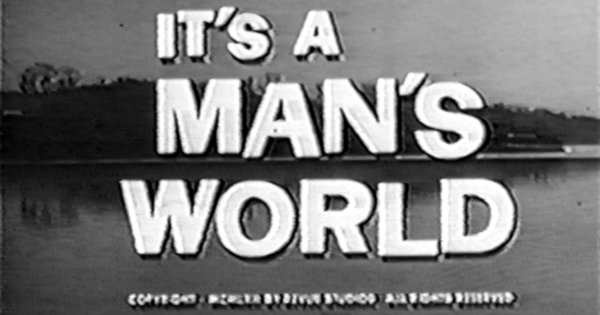
Critics praised this NBC drama when it debuted in September 1962. But viewers didn’t tune in and the network soon cancelled it. Despite a campaign to save the show involved the creator, the cast, TV critics, and fans from across the country, NBC refused to reconsider its decision and the show went off the air in January 1963 after just 19 episodes.
A Difficult Series To Define
On February 12th, 1962 Broadcasting reported on the state of the networks’ upcoming 1962-1963 schedules. Tentatively slated for the Mondays 7:30-8:30PM time slot on NBC was a new show from Revue Productions called The Young Men, described as a comedy-adventure [1]. It would compete with Cheyenne on ABC as well as games shows To Tell the Truth and I’ve Got a Secret on CBS.
The following week, Broadcasting called The Young Men one of “the new programs most likely to succeed in gaining an NBC-TV niche” [2]. In March, The New York Times officially announced the series, now called It’s A Man’s World, explaining that it would follow the adventures of four young men living on a houseboat on the Ohio River [3]. Peter Tewksbury would produce and direct.
Hinting at the troubles the series would encounter once it hit the air, early press about It’s A Man’s World suggests reporters had some difficulty categorizing the show. It was referred to as a comedy series, an adventure series as well as a comedy-adventure series.
In late May, Broadcasting reported that Procter & Gamble had been signed to sponsor the series on an alternate-week basis, with additional time remaining to be sold [4]. In June, Thomas Leeming & Co. signed on for 26 weeks of the series [5]. And in July, Chesebrough-Pond’s Inc. bought participation in the series as well [6]. When NBC announced in late July that it would be cutting back its compensation to affiliates and, to help lessen the blow, would try to make two minutes for station time available in a pair of prime time series: The Wide Country and It’s A Man’s World [7].
Four Young Men On A Houseboat
The series was set in the fictional small college town of Cordella, Ohio. Glenn Corbett starred as 22-year-old Wes Macauley, who studied at Cordella College while working as a gas station attendant. He also cared for his 14-year-old brother Howie (played by Mike Burns). Their parents died in a car accident prior to the start of the series.
Wes and Howie lived on a houseboat named The Elephant, which was docked on the Ohio River near Stott’s Service Station, where Wes worked. It was owned by the cantankerous Houghton Scott (played by Harry Harvey, Sr.), who served as something of a father figure for both Wes and Howie. Mr. Stott loved complaining to anyone who would listen, about someone leaving their running lights on during the day or the phone ringing too often. But he genuinely cared for the boys, particularly Howie. The two often played checkers together.
Living with Wes and Howie on the houseboat was another college student named Tom DeWitt (played by Ted Bessell). His nickname was Tom-Tom and he grew up in Chicago as part of a wealthy family. He flouted their expectations and decided to go to school in Cordella rather than the big city. In the series premiere, Wes, Howie and Tom-Tom meet Vern Hodges (played by Randy Boone), a carefree guitarist from North Carolina who wants to become a folk singer and get rich. Instead, he winds up moving into the houseboat in the second episode.

Wes was engaged to Irene Hoff (played by Jan Norris), who was also attending college in Cordella. She was a sweet girl with a feisty streak who had no problem jumping into the middle of an argument between the boys. Other characters making occasional appearances included Iona and Virgil Dobson (played by Kate Murtagh and Scott White), friends of Mr. Stott who ran a grocery store in Cordella. Their daughter, Alma Jean (played by Jeanine Cashell), had a crush on Vern. There was also Tom-Tom’s sometimes girlfriend Nora (played by Ann Schuyler). Sandy Mills appeared in at least two episodes as Irene’s married sister, Helen.
The legal agreement that allowed Wes to act as guardian for Howie meant he had to have a stable home environment. So there was no drinking on the houseboat and no girls spending the night. Wes didn’t like treating Howie like a kid and Howie didn’t usually act like one. Still, it wasn’t easy for Wes to juggle work, school and raising Howie.
Tom-Tom wasn’t nearly as responsible as Wes, particularly when it came schoolwork. Vern was shy and introverted but also a wild dreamer. As for Howie, he was at the age where he was starting to notice girls but wasn’t sure how to act around them.
A Different Kind Of Television Show
It’s A Man’s World was created by Peter Tewksbury and James Leighton. The two had earlier worked together on My Three Sons during its first season on ABC from 1960-1961. Tewksbury produced and directed the season in its entirety — all 37 episodes — while also writing the occasional episode. Leighton worked as story editor and also penned several episodes.
The series had its beginnings in the backlot at Revue Studios in California, specifically a town locale that had been used in the production of Leave It To Beaver, among other shows. Tewksbury, born in Cleveland, Ohio, felt it “had a nice, small-town, Midwest setting” and thought it would fit with “the studio idea about a series on youth in which youth has dignity” [8].
According to Tewksbury, the point of My Three Sons “was to give the boys some stature” and with It’s A Man’s World he hoped to take things even further and “have the boys work out their own problems” [9]. He took a trip across the country and ended up in Marietta, Ohio, which borders the Ohio River and is home to Marietta College [10]. He liked what he saw and spent three weeks shooting exteriors along the river, the town and at Marietta College [11]. It was only then that casting began.
In describing the tone of the series, Tewskbury noted “if the audience is expecting a comedy, they may get a jolt. I guess human comedy comes closest, since pathos relates to all shows. There are sad laughs and funny tears to be had. We are aiming for a theatrical slice of life, because after all, what is life but a sad joke” [12]. He admitted it was “hard to describe the series, because there is no one show that tells what it is” but said he didn’t “expect any problem with the public. They’ll like the people, and become involved with them, and want to spend time with them” [13].
Cynthia Lowry, writing prior to the premiere of the series, called It’s A Man’s World “a standout” in a season “marked by a paucity of new, fresh ideas” [14]. According to her, Tewksbury considered the series a “permanent character anthology” who explained “we’re trying to get something that falls among J.D. Salinger, Thornton Wilder and Maxwell Anderson and to give it an ‘Our Town’ feeling–maybe it’s even avant garde but we hope nobody in the audience knows it” [15].
Of his youthful characters, Tewksbury said “we give them dignity and a positive point of view. We don’t develop them as idiotic or comic teen-agers or go in for the youthful nut-stuff. We try to say that youth has substance” [16]. Said actress Jan Norris, “We want to take people out of themselves or offer highlights in their lives. Incidents in the series, we hope, will remind people of the sometimes pleasant situations in their lives” [17].
Norris described her role of Irene Hoff as “a livable role. I don’t play a kook or somebody so different from the viewers” [18].
Critical Adoration
Cynthia Lowry wasn’t the only television critics excited about It’s A Man’s World prior to its television premiere. Hal Humphrey likewise felt the series was something special, calling it “the first seen by this reporter which has anything looking even slightly different from the ordinary, polished product coming out of Hollywood now” [19]. What made it different was “the simple technique of writing about real characters and letting them tell their stories with half as much dialogue as one finds in most TV drama” [20].
In his review of the premiere for United Press International, Rick Du Brow suggested It’s A Man’s World “might be the sleeper of the year” and called the first episode “a gentle, pointed lesson in personal morality, the approach obviously aimed at showing that not all youngsters are juvenile delinquents or idiots; and the whole thing added up to a paean to normality, with a lovely, almost impressionistic quality reminiscent of ‘The Human Comedy'” [21].
Alan Gill, writing in The Portsmouth Times, was not particularly impressed by the premiere, calling it “a 60-minute affair with a 10-minute plot” in which “confusion, artiness, plot anemia and sweet talk abounded.” Nevertheless, he felt there was “much hope for the future” of the series [22]. He called the setting “extremely photogenic” and the scenery “beautifully composed and photographed” [23].
The Boston Globe‘s Percy Shain, on the other hand, found little to redeem the series. He wrote “its opening story was one long yawn. In fact, properly speaking, it was no story at all. Just a start at getting you acquainted with a lengthy and confusing cast of characters” [24]. His review returned time and time again to the pace of the premiere:
It’s easy to see what Peter [Tewskbury] is driving at–a small-town series with small problems, some cute people in a bucolic background, full of homely widsom [sic] in a light way. It’s surely wholesome enough, for which we must give thanks, but it will have to start getting you interested in its people if it is to have weekly appeal.
Perhaps it needs more time to make an impression, because its personnel and relationships are so numerous and unwieldy that it’s all kind of puzzling at the moment.
[…]
No one is rushing in this one. But they may find that by the time they have everyone settled, they may have lost their audience. [25]
Shain did have kind words for some of the cast, calling Glenn Corbett “a manly, likable stalwart” and Jan Norris “sweet” [26].
Stories of Friendship, Life and Love
The focus of the series was on the relationships between the characters, be it Wes and Howie, Wes and Irene, Howie and Mr. Stott, Wes and Tom-Tom, or Tom-Tom and Vern. In the series premiere, as Wes and Tom-Tom fret about money and taxes, Howie is in a panic after losing the $32 he made selling newspapers. He and Wes, joined by their friends, begin a search for it. Vern, having just entered town, stumbles upon the money and thinks about keeping it before deciding to return it to Howie.
The second episode continues the plot of the first, pitting Wes and Tom-Tom against one another over the question of whether or not to let Vern live in the houseboat with them. At the same time, Wes is also trying to get Tom-Tom to help around the houseboat. Ultimately, they decide to let Vern move in and the three boat mates become four.
Howie took front and center in a number of episodes, including one in which he begs Mr. Stott for a job and, after being turned down, starts working after school for an insurance salesman long past his prime, which makes Mr. Stott jealous. In another, Howie is struck by lightning while on a a weekend camping trip with Tom-Tom and Vern. He wanders off, trying to make his way home, and gets lost in the woods where he starts to hear his mother’s voice calling to him.
Wes and Irene’s relationship was also the focus of several episodes. In one, Wes promises to make it to the party Irene is planning. But he has to run an errand first. On his way back he comes across Nora, whose car has broken down, and offers her a ride. He’s transporting a load of tires that come loose and the two find themselves chasing tires down a hill. They wind up in a pigpen covered in hay. When they finally make it back to the party Irene is not happy. In another, Wes and Irene desperately try to find time to spend together away from work and school and friends. They eventually wind up in an empty house, at night, finally alone.

Several episodes focused on Tom-Tom: despite not having any money, he sets his eye on classic car and decides to find a way to buy it; he finds himself in trouble when he starts dating the girlfriend of paratrooper, leading to an awful lot of gossip and a showdown between the two; after being suspended from school due to low grades, he has to go back to Chicago and face his parents.
Vern also had his share of stories. In one episode, after brooding for several days, he decides to drive over to Exeter, a nearby town with a reputation for trouble. He takes Howie with him, which eventually leads to Wes, Tom-Tom, Irene and Nora desperately chasing after the two to save Howie. It turns out Vern was just homesick. In another episode, Vern decides to take Tom-Tom’s advice and become more outspoken and self-confident, which doesn’t go over well.
Other episodes involved Tom-Tom promising to return some books for Wes only to find himself distracted; Wes tries out for the Cordella College football team and doesn’t have time for Irene; Alma-Jean Dobson decides she doesn’t want to be friends with Howie anymore because her mother thinks she needs to start growing up; Irene has Wes take an aptitude test for her psychology class which reveals he isn’t cut out to be a lawyer; Vern falls for a waitress who flirts too much; Tom-Tom, Vern and Howie head out on the river with Mr. Stott only to discover he’s a real bore, so they ditch him and soon find themselves in trouble.
Early Ratings Woes
It’s A Man’s World premiered on Monday, September 17th, 1962, airing from 7:30-8:30PM opposite Cheyenne on ABC and a pair of games shows — To Tell the Truth and I’ve Got a Secret — on CBS. It was followed at 8:30PM by Saints and Sinners (another new NBC drama starring Nick Adams) then the half-hour The Price is Right at 9:30PM and finally David Brinkley’s Journal at 10PM.
The third episode of the series (“Molly Pitcher and the Green-Eyed Monster”) was scheduled to air on Monday, October 1st during NBC’s “color week” which would see some 66 hours of color programming on the network, including all but five of its prime time shows [27]. Television listings do indeed indicate that It’s A Man’s World would air in color on October 1st. However, NBC pre-empted the series at the last minute to air an hour-long news special covering the riot that had broken early in the day at the University of Mississippi [28].
“Molly Pitcher and the Green-Eyed Monster” would air the following week on October 8th and again television listings state that it aired in color.
Late that month, Rick Du Brow wrote an article praising the series for being “sharply attuned to the laughter and tears of the everyday human comedy” while also reporting that its chances of survival were “questionable at present” due to its performance in the Nielsen ratings [29]. He asked readers to watch the series and write the network to help keep the show on the air [30.
Du Brow soon became a champion for the series, writing again in early November that it “had an uncertain status because of its poor ratings” and commending Tewksbury for “his refusal to compromise the life-like pace” of It’s A Man’s World [31]. Also supporting the series was Hal Humphrey, who discussed the difficulties in promoting the series in his own early November article. “For some inexplicable reason,” Humphrey opined, “NBC seems almost ashamed of having the most original TV series on the air this season” [32].
NBC didn’t know how to publicize It’s A Man’s World, Humphrey argued, something he chalked up to it not having an easy label and its characters being “too normal and honest” [33]. He reported that Jan Norris was so discouraged by the network’s lack of publicity that she paid $54.60 out of her own pocket to purchase bold advertising lines in the television listings for 11 Los Angeles newspapers. Tewksbury told Humphrey “I’m sure we’re on the right track because the viewers from our mid-western states are beginning to write letters, telling us how much they like the show because it reminds them of what’s going on in their own town” [34].
Humphrey called It’s A Man’s World “the first hour-long TV series to do what writers and producers of hour shows have babbled about ecstatically, but hardly ever do–‘develop character’ and ‘build real stories'” [35]. He criticized some of the editing of the series, which featured “too many rapid-fire cuts to too many different locales,” but concluded that when a series like It’s A Man’s World came along “there should be some noise made about it so that everybody has a chance to discover what they have been missing and the producer and network can be encouraged to carry on” [36].
Cancellation Comes Swiftly
On November 22nd, Val Adams of The New York Times reported that NBC was “studying a possible reorganization of Monday evening programs to improve its competitive position” and noted that Monday was the network’s weakest night of the week [37]. Although he called Saints and Sinners the most likely candidate for cancellation, both It’s A Man’s World and The Price Is Right were also said to be in danger.
A disappointed but not surprised Rick Du Brow reported on November 27th that It’s A Man’s World had been cancelled the previous day due to low ratings and would go off the air after its January 28th, 1963 broadcast. So, too, would Saints and Sinners. Du Brow revealed that NBC had released a statement about the cancellation, apparently in response to critics and viewers who supported the series. The network explained that the series was its lowest rated entertainment program and “if we had continued, we would have no sponsors to the show by Feb. 1. Also we would have had loss of stations. The network is made up of stations” [38].

Val Adams reported on November 29th that rather than replacing It’s A Man’s World and Saints and Sinners NBC decided to create a two-hour Monday night block of feature films culled from a package the network purchased from 20th Century-Fox. At the time, NBC was already airing Fox films on Saturday evenings. The package consisted of sixteen films produced in 1957 and 1958 and NBC was given the option to air each one twice. It would be enough to finish out the 1962-1963 season after which the network would be able to introduce new shows on Monday night for the 1963-1964 season [39].
The Campaign to Save It’s A Man’s World Begins
Also on November 29th, Peter Tewksbury placed calls to television critics in cities across the country, telling them of his plan to save It’s A Man’s World. He didn’t believe NBC’s explanation for its cancellation, that it was low rated and would soon lose all its sponsors. Said Tewksbury, “I know for an absolute fact that NBC canceled THEM [the sponsors]. Only one sponsor dropped out; none of the others canceled or even said they were going to cancel” [40].
A letter writing campaign could save the show, Tewksbury thought, because it had worked for Father Knows Best. The 19th and last episode of It’s A Man’s World wrapped filming on November 28th. The cast, according to Tewksbury, was “a real unhappy group” that “felt all along they were doing something significant, something people really cared about. Now they wonder if we shouldn’t have spent our time letting a little blood run in the gutter” [41].
Hal Humphrey joined the fight in early December, urging viewers to write NBC in support of It’s A Man’s World or surrender forever to the Nielsen rating system. According to him, Tewksbury had gone to NBC to fight for the series only to learn that the decision to cancel it had been made two hours before he arrived.
In Tewksbury’s words, the network “didn’t want to debate the matter. It frightened me to see a network in the hands of this scared-boy type of control” [42]. He planned to “travel this country from coast to coast” and talk to anyone that would listen. He refused “to believe that people don’t want quality in their entertainment and I’m going to find out” [43].
According to NBC-TV vice president Walter Scott, the multi-network rating for It’s A Man’s World was 8.6, compared to a 13.7 for Cheyenne on ABC and a 20.1 for To Tell The Truth on CBS. Tewksbury countered that “this particular Nielsen rating was the first all-purpose one of the season, that it already was three and a half weeks old and that only four ‘Man’s World’ shows had been on the air when it was taken” [44]. NBC didn’t deny the facts but explained ratings were all they had to work with.

A few days later, Humphrey reported that NBC had received thousands of letters in support of It’s A Man’s World, said to be the fastest response to a cancellation the network had ever seen. And yet NBC wasn’t moved. “I don’t care if we get two million letters,” Walter Scott reportedly said. “The decision to cancel ‘Man’s World’ is irrevocable” [45].
At NBC’s annual affiliates meeting held on December 4th and 5th in New York City, President Robert E. Kitner told station representatives that the network was obligated to gamble on programs but that sometimes those gambles didn’t pay off. He said NBC had invested millions of dollars in It’s A Man’s World only to find itself accused of “lack of creativity” for cancelling the show when it failed in the ratings [46].
Randy Boone told Hank Grant in mid-December he couldn’t understand the cancellation. The show, he said, was “so true to life, so warm and full of the human touches that really count in life. None of us ever thought we were acting a part–we were living our roles. Why should they cancel it? We’ve been getting so much wonderful mail from people; I’m told, more than any show on this [Revue’s] lot” [47].
Grant also reported in mid-December that Tewksbury had set out on “a cross-country tour with a one-man campaign to rally TV editors into helping him keep his series alive” [48]. He also entered two episodes of the series in the Television Festival of Monte Carlo [49]. Randy Boone and Ted Bessell also hit the road hoping to rally support but broke down in New Mexico and had to be towed to Albuquerque [50].
Cynthia Lowry reported that Boone and Bessell had traveled to Marietta, Ohio on December 18th and participated in a demonstration at a local television station alongside students from Marietta College [51. The campaign continued into the new year. For several weeks in early January 1963, an announcement was run in the classifieds section of The New York Times in support of It’s A Man’s World. Anyone interested in saving the series was asked to call a number or write to an address in Berkeley, California [52].
On January 13th, Hank Grant revealed that NBC announced it had received exactly 9,499 in support of the series through the week of December 23rd. It was a big number but not a record for the network and certainly not the reported thousand letters a day [53]. (In May 1965, The New York Times would report that NBC was sent 51,638 letters of protest in total after the cancellation of It’s A Man’s World was announced [54].)
The Campaign Fails
Even as Tewksbury, some television critics and thousands of fans were trying to save It’s A Man’s World, other critics were ready to say goodbye. Jack Gould of The New York Times, in a December 22nd article, admitted that Tewksbury’s push to save the series “must be admired” but wrote “the only drawback in this campaign is that his program is not really that good” [55]. He continued:
The major difficulty, however, was that Mr. Tewksbury placed his quartet in a houseboat, hardly a very typical setting for most youngsters, and then proceeded for more weeks than not to make his characterizations a set of bores.
Trying to capture the essence of any young age group requires a high order of delicacy and discernment and also an underlying warmth. “It’s A Man’s World” does not regularly have such qualities, and the upshot is a show that often seems only pointless. Certainly its standard cannot be mentioned with that of “Father Knows Best.”
What Mr. Tewksbury overlooked, as a matter of fact, was the most engaging quality of young people: their sense of humon [sic]. Under the circumstances the loss of “It’s A Man’s World” would not seem irreparable. [56]
Reportedly, members of the cast traveling the country in support of the series made it all the way to the RCA Building at Rockefeller Center in New York City, where they entered the lobby and asked to speak with Robert Kintner, president of the network. In what could be considered the high water mark of the campaign, they were able to talk to a vice president who simply explained the reality of the situation [57].
Ultimately, and perhaps not surprisingly, the campaign to save It’s A Man’s World did not result in the series returning to the air. The premiere of NBC Monday Night at the Movies on February 4th, 1963 from 7:30-9:39PM greatly improved upon the ratings drawn by the final episodes of It’s A Man’s World and Saints and Sinners the week before. More than six million additional households tuned in to watch 1957’s The Enemy Below.
NBC was so impressed that within a month, it had announced it would purchase rights to over 60 feature films so it could keep Monday Night at the Movies going through the 1963-1964 season. Advertisers were than happy to purchase commercials. An anonymous advertising agency executive explained “movies on TV have a name value. Sponsors who buy movies are buying numbers or heads and the movies deliver an incredible number of viewers. Advertisers couldn’t care less about creative TV programs. They are looking for a vehicle that will get their advertising message into the home” [58].
Aftermath
In a lengthy essay published in the January 17th, 1963 issue of The Village Voice, a few weeks before the series went off the air, Martin Williams eulogized It’s A Man’s World:
It has been, heaven knows, an uneven series, but it has tried with an uncommon effort to present us with the reckless energy, the time-wasting idleness and boredom, the friendliness, the sexual awakenings, and the loneliness of young people who are not rosy cliches.
The series has also made a most interesting and frequently effective effort to discover just exactly how many cinematic techniques will come across on filmed television, and that is a job that certainly needs to be done. [59]
Williams praised the characters, the stories and the “exceptional care” with which the series was edited. He also expressed frustration at NBC for its lack of support of the series as well as with critics who “treated it with an airy contempt more than once” [60].
Although he wasn’t able to save It’s A Man’s World, Peter Tewksbury remained incensed by NBC’s treatment of the show. In March 1963 he testified at a hearing held by a subcommittee of the United States House of Representatives Commerce investigating audience measurement and rating services. He charged that the “entire television industry is completely controlled by the Nielsen ratings” and “if you’re willing to put up enough money for promotion and publicity you almost automatically get a good rating” [61].
Tewksbury noted that It’s A Man’s World had been given a very small budget for promotion, just 5-10% of what other shows he had worked on received, and had been scheduled at a bad time in the Midwest [62]. He would later reportedly accuse NBC of tampering with the ratings for the series to justify cancelling it [63].
The series was never syndicated in the United States nor released commercially on any format. It was syndicated internationally. For example, in December 1963 Broadcasting reported that it was one of nine NBC shows sold to the Philippines [64].
Works Cited:
2 “Comedy Centers TV Stage for Fall.” Broadcasting. 19 Feb. 1962: 32.
3 “3 One-Hour Series Planned By N.B.C.” New York Times. 21 Mar. 1962: 79.
4 “Business briefly.” Broadcasting. 28 May 1962: 38.
5 “Business briefly.” Broadcasting. 26 Jun. 1962: 45.
6 “Business briefly.” Broadcasting. 16 Jul. 1962: 31.
7 “Affiliate pay cut essential — NBC.” Broadcasting. 30 Jul. 1962: 43.
8 Witbeck, Charles. “From Conception to Filming: How a New Video Series is Created.” Toledo Blade. 19 Aug. 1962: 7A.
9 Ibid.
10 Lowry, Cynthia. “Fall TV Series Has Fresh Material.” Gadsden Times [Gadsden, AL]. Associated Press. 1 Sep. 1962: 20.
11 Witbeck, Charles. “From Conception to Filming: How a New Video Series is Created.”
12 Crosby, Joan. “He’s in a Man’s World 24 Hours a Day.” The Saratogian. 15 Sep. 1962: 10.
13 Ibid.
14 Lowry, Cynthia. “Fall TV Series Has Fresh Material.”
15 Ibid.
16 Ibid.
17 Purcelli, Marion. “Breakfast With Jan.” Chicago Daily Tribune. 27 Oct. 1962: E3.
18 Ibid.
19 Humphrey, Hal. “Television and Radio: Who Needs To Think About New Season?” Portsmouth Times. 10 Sep. 1962: 10.
20 Ibid.
21 Du Brow, Rick. “Strong Commercial Effort: ‘Saints and Sinners’ Debuts.” Eugene Register-Guard [Eugene, OR]. United Press International. 18 Sep. 1962: 8A.
22 Gill, Alan. “Television and Radio: A First Spark.” Portsmouth Times. 26 Sep. 1962: 26.
23 Ibid.
24 Shain, Percy. “Night Watch: World of City Room Clumsily Portrayed.” Boston Globe. 18 Sep. 1962: 6.
25 Ibid.
26 Ibid.
27 “Color tempo increases.” Broadcasting. 24 Sep. 1962: 48.
28 NBC took out a one-page advertisement in the October 4th, 1962 edition of The New York Times to explain that Monday, October 1st had been an unusual day for the network; the text noted that It’s A Man’s World had been pre-empted by an hour-long special that included “exclusive interviews with key figures in the controversy” (Page 60).
29 Du Brow, Rick. “Take in Whole Picture.” Knickerbocker News [Albany, NY]. United Press International. 30 Oct. 1962: 15A.
30 Ibid.
31 Du Brow, Rick. “Critic Finds Hillbillies Show Most Popular New Series.” Reading Eagle [Reading, PA]. United Press International. 6 Nov. 1962: 18.
32 Humphrey, Hal. “What It Takes to Gain TV Favor.” Los Angeles Times. 6 Nov. 1962: D14.
33 Ibid.
34 Ibid.
35 Ibid.
36 Ibid.
37 Adams, Val. “N.B.C.-TV Studies Its Weak Monday.” New York Times. 22 Nov. 1962: 67.
38 Du Brow, Rick. “Series Cancelled Because of TV’s Rating Problem.” Tonawanda News [Tonawanda, NY]. 27 Nov. 1962: 9.
39 Adams, Val. “N.B.C.-TV Plans Films On Mondays.” New York Times. 29 Nov. 1962: 75.
40 Hawver, Walter. “Let’s Save This ‘World’.” Knickerbocker News [Albany, NY]. 30 Nov. 1962: 16A.
41 Ibid.
42 Humphrey, Hal. “Battle is On to Prove Rating System Faulty.” Long Island Star-Journal. 3 Dec. 1962: 10.
43 Ibid.
44 Ibid.
45 Humphrey, Hal. “Cancellation Stirs Fans; NBC Execs Adamant.” Long Island Star-Journal. 7 Dec. 1962: 20.
46 “Bulls are loose in Rockefeller Plaza.” Broadcasting. 10 Dec. 1962: 52.
47 Grant, Hank. “Feels It’s All So Complicated.” Binghamton Press [Binghampton, NY]. 15 Dec. 1962: 4.
48 Grant, Hank. “The TV News Beat.” Hartford Courant. 16 Dec. 1962: 6G.
49 Gould, Jack. “TV: A Survival Fight.” New York Times. 22 Dec. 1962: 5.
50 Denton, Charles. “Don’t knock Re-Runs to Dick Van Dyke!” Hartford Courant. 23 Dec. 1962: 10G.
51 Lowry, Cynthia. “Campaign to Save ‘Man’s World’ Hits College Town.” Ocala Star-Banner [Ocala, FL]. Associated Press. 24 Dec. 1962: 2.
52 One such announcement ran in the January 3rd, 1963 edition of The New York Times (Page 11).
53 Grant, Hank. “The TV News Beat.” Hartford Courant. 13 Jan. 1963: 10H.
54 Reed, Rex. “Reading Between The Lines.” New York Times. 16 May 1965: X12.
55 Gould, Jack. “TV: A Survival Fight.” New York Times. 22 Dec. 1962: 5.
56 Ibid.
57 Shepard, Richard F. “‘East Side” Solicits Support for Renewal of TV Show.” New York Times. 10 Jan. 1964: 87.
58 Adams, Val. “Formula: More Movies.” New York Times. 7 Apr. 1963: X23.
59 Williams, Martin. “‘It’s A Man’s World’ Ends–How to Fail by Succeeding.” The Village Voice. 17 Jan. 1963: 9.
60 Ibid., 12.
61 “Rating Services Seen Controlling Broadcasting.” Hartford Courant. Associated Press. 8 Mar. 1963: 22A.
62 Ibid.
63 Freeman, Alex. “Emcee Job Costly to Red Buttons.” Hartford Courant. 19 Mar. 1963: 22.
64 “Abroad in brief…” Broadcasting. 31 Dec. 1963: 46.
Originally Published April 26th, 2006
Last Updated April 26th, 2018


Whatever happened to Jan Norris? She started out on TV in 1957, and was also in that “Splendor in the Grass” movie in 1961, onto Bonanza in 1965, but then a skip of 30 years “To The Beat of the Drum” in 1995. I have a “TV Topics” from Buffalo, N.Y. of her on the cover with Edward Andrews and June Havoc in “The Pink Burro” from The U.S. Steel Hour that I’d like to send to her with a SASE for an autograph. Sat.July11,1959 Can anybody help? — Joe P.S. My cousin lived on a houseboat for a while, plus don’t forget “Surfside Six” and “Riptide” with guest star “Honey West”.
Jan Norris is no longer with us.
I was a fan of the show when it aired in the 1960’s, and I was also taken with actress Jan Norris, who seems to have vanished. I read somewhere that she passed away. Does anyone know what happened to this beautiful young woman, and gifted actress?
Hi there. this site is a real godsend to me.
I have been looking for references to “It’s a man’s world” for years & began to think it was in my imagination!!
I also remember a B/W series like “It’s a man’s world” with a beatnik type of really cool guy who made aside-style comments in the episodes about the other characters (in the same way that George Burns used to do about Gracie).
This ‘beat’ guy was a trumpet player & looked like Jack Sheldon, the famous trumpeter, who also acted in series called “Run Buddy run”.
Do you know the beat guy & the series please help if you can
Lynne
the january 26-feb1-1963 issue of tv guide has an article about iamw you can find on ebay for 5 dollars
all 19 episodes of iamw are avaiable google serch : e/p partners tv
Brian
I went to the site you showed : e/p partners tv but I couldn’t find out how to buy copies of the series.
Like Lynne I was beginning to think this great but short lived TV show was a figment of my imagination.
As a very young teenager I remember thinking that this show was
very “cool,” in the vain of Route 66, another of my favorites back then. I was heartbroken when the show was so callously cancelled early on into it’s run.
How I envied these guys and their lifestyle. Still do all these years later!
Great memories. Thanks for putting them here.
I was 13 when this show was aired … a big fan … I remember it well
I was 13 when the show aired, I am almost 61 now and I still remember the show well. It was one of my favorites. When ever I bring the show up to people no one else remembers it. They all think I imagend it.
This site is truly astonishing! I, too have fond memories of this show as a 12 year old and could find no one who had ever heard of it. Does anyone recall the episode in which 10s of tires rolled down a steep pasture (think West Va highlands) toward a female character sitting in a stock tank (fully clothed)? I’d love to get an audio of the theme song.
Jan Norris died in 1985 from a Brain Hemmorage she suffered in about 1965….She was very disappointed with the cancellation of the series and started working in Public television. If anyone knows how to find any copies of her work I’d love to hear about it….
Clint
A pity that she and Natalie Wood, who both starred in Splendor,
died in their mid forties.
I remember an episode where “There is a Tavern in the Town” played a part. I was 12 when the series aired and was disappointed when it was canceled. Though for some reason I keep thinking Sandy Dennis was in it. I must have it mixed up with something else similar.
I will definitely look for episodes on the internet.
the episode with tires rolling down hill is molly pitcher and the green eyed monster
I, too, was a great fan of this show. Glen Corbett appeared as Zephron Cockran( unsure of spelling) in a Star Trek episode. Ted Bessell went on to other rolls and passed away some years ago.
I remember the Bessell character sitting with his girlfriend in a cemetery, but I have no idea of the context for the scene. Does anyone know either the name of the character or the name of the actress who appeared as the girlfriend?
I’m happy to see that so many people also enjoyed the show.
The episode I’v always remembered featured Ted Bessell, possibly just knocking around aimlessly for much of the episode – and (for some reason) his reading of a poem from Winnie the Pooh. He read “Three cheers for the wonderful Winnie the Pooh – Will somebody tell me, What Did He do??” It was downright existential.
I always thought the show was a little more cerebral than it seems (from the summaries of the plots!) it really was.
I was heartbroken, too, when it was canceled so soon.
I am thrilled to read your message!!! I too remember Ted Bessell bouncing around the houseboat and reciting the passage from Winnie the Pooh (which was a great love of my early childhood). I am so happy to learn that there are still many who felt as I did about the show. I loved It’s a Man’s World enormously, and was crushed when it was cancelled. I still have a letter Jan Norris sent me in response to a protest I filed about the cancellation.
i was just a kid of 13 when this show was on and i can remember the tune but i think it had no words. i still can whistle it and no one seems to remember this great show but myself. i too think it was a fantastic forgotten show and im looking for the music with no results…thank you for bringing this to everyones attention and if anyone can find the music email me thanks!
What I find fascinating is how many people thought that they imagined this show.
I was 11 at the time and have wondered if the show really existed for years. It
touched a cord in our minds of an alternative lifestyle in an era when this did not
exist. An early marker of the changing times in the sixties, perhaps!
I was an extra, stand-in, double and bit player on “It’s A Man’s World.” Universal owns the rights and has the films unless they’ve been moved to The Academy of Television Arts and Sciences Archives at UCLA. The best thing we can do is encourage the Academy Archives to get all of them transferred from Universal to their care. That way they will be kept safe. As for the actors: most know that Michael Burns became a PhD and is retired from teaching in Danville, KY; Randy Boone (at latest word) is back in Fayetteville, NC; Ted Bessell died of a brain aneurysm, and Glen Coirbett died of lung cancer. Both Peter Tewksbury and James Menzies, the Show’s creators have also passed away. Kate Murtagh (“Mrs Dobson”) is at The Motion Picture Country Home. A bit part – I am Randy Boone’s rival for the attention of actress, the late Diane Sayer, in the episode entitled “I Count My Life in Coffee Cups” – am retired and live in the Kansas City area.
Hey Bill, I am a fan of Diane Sayer and I would love to talk further. My email is [email protected]. Thanks.
I loved this show as a 16 year old teenager who fantasized about living that lifestyle (which I actually did later as a young adult when I spent 3 years living on a houseboat in Seattle’s Lake Union!) I, too, have encountered blank stares from people when I mention the show and that huge letter-writing campaign to try and save it. Guess it was on for too short a time for many to have experienced. Too bad. It was ahead of it’s time–extremely well crafted, well acted, and thoughtful. I regret that so few people were able to see it.
I, too, recall the show as a 16 year old who fantasized about living that lifestyle (which I later did as a young adult when I lived for 3 years aboard a houseboat in Seattle’s Lake Union!) I recall the huge letter writing campaign to try to save it, yet I get blank stares from others when I mention the show or that letter writing effort. Too bad as it was well crafted, well acted, and ahead of its time. Glad a few others of you recall the show as I always have.
I am 62 and from Sydney Australia. I have always remembered this show as one of my favorites. Not forgetting Leave it to Beaver. Bonanza, The Honeymooners and The Hathaways to name a few. Have just discovered this site, so will be seeing what other memories it brings.
This iS astonishing. A show that lasted half a season, a show which has been erased fro the history books( Ironic, considering that Michael Burns became a distinguished historian later on)) And yet, dozens of people remember it. To give you a clue about how fondly this sghow is remembered, over two hundred people on Facebook list it among their “likes’, as opossed to 35 for Slattery’s People and just 2 for Channing. I never saw it, as my father loved Cheyenne..reading everything that is posted about it, I really regret never seeing it, or knowing about it it till now..
Please, somebody, release this on DVD.
Joseph, be sure to check back in a few days for my revised article on It’s a Man’s World, which will included a greatly expanded overview of the effort to save the series.
Looking forward to it. I am working on an article called Twenty Terrific Television programs you have (probably ) never seen, which I hope to submit to Cracked ,com. It will be written in a comic style, but i want to make the serious point that there is alot of wonderful stuff that has has not been seen in years.
BTW, when are you looking at Channing? That was one odd show, with gigantic strengths and almost equally big problems.
The article was fascinating. From all i have been able to gather, Its A Mon’s World has fans all over the world. In fact, over 220 people on Facebook list it as one of their favorite shows, including folks in i ndia, The Phillipines,Zambia and Australia( Where it was a run-a way hit. A few years ago, The New York Ties had a long article on it that included an interview with Tewkesbury.
I have now come to the conclusion that the Nielsen Rating are demonic, and may well be a mind control device created by either The Shadowy Syndicate or The Black Lodge.
I was fourteen when the show aired and I loved the half dozen or so episodes I managed to see (my parents didn’t share my interest, alas). The scene with Tom-Tom coping with his inner demons by doing the “Hurray for Pooh” shout-out has stayed with me for half a century (and the fact that my father ridiculed it as nonsense didn’t change my opinion then or now). I’d love to be able to see it again, in any format and at almost any price. . .
Apparently, not everybody likes the show. Somebody named “Stephen Bowie” who edits a site on TV history scorns it as “Peter Tewkesbury’s vanity project”, and speaks of a “Chimpanzee named “Ted Bessell” “. Well, I have a sneaking suspicion that “Stephen Bowie” harbors a deep prejudice against anything that isn’t “edgy” or “transgressive”, whether it be Friday Night Lights, The Great Adventure, HomeFront, or, of course, anything that, Secular Humanist Paradise on Earth forbid, might actually portray religious people or conservatives, or, for that matter, just plain small town Americans, in a favorable light,
Recall that not every critic liked the show back in 1962 either. There were a lot of loud voices supporting the show but at least a few who were not impressed.
You are right. I also know that there are very intelligent people who claim to dislike Proust or Dostoevsky. I was a little too acerbic toward Mr. Bowie. Still, it is remarkable how many of the fans of “Its A Mans World ” Can be found in foreign countries. In fact, the number of “likes ” on Facebook is amazing. Channing has about 7, Slattery’s People and The Great Adventure, less than twenty. Its a Man’s World has 224. There must be something to this show,.
Nice to know that many people out there still remember this little gem from the fall of ’62. I was truly disappointed to see the obits at the time of Ted Bessell’s
unfortunate passing basically relegating him to a memory as Marlo Thomas’s boyfriend on THAT GIRL, totally ignoring his wonderful early work as Tom DeWitt on IT’S A MAN’S WORLD.
This was, in my opinion, the high point on the resume of everyone involved, including series composer Jack Marshall, who, because the main title was woven into the opening scene of the show, was given the chance to do new and varied arrangements of the theme almost every week, sometimes a new theme altogether.
google : gregstackhouseprevost.com click on services e/p partners tv
I loved this show, watched it in Australia, wher I live.
I was 14, had just lost my father; it was wonderful to see depicted real people with genuine emotions on TV.
The linked continuing story format allowed the both the characters grow, as well as my involvement and admiration.
I was sorry to miss out on more.
I’m also from Australia and loved this show. And I too began to think I must have imagined it, except I could never have imagined anything this well written and acted. My favourite memory is of an episode where Glenn Corbet falls into a swimming pool while arguing with his girlfriend and spends almost the whole rest of the episode here, just talking to her. Imagine a static scene like that in a show today, reliant just on the quality of the dialogue. This show really plowed new ground, but unfortunately nobody came after to sow the seeds.
My letter to the editor in Newsweek in support of IAMW was chosen out of hundreds they received after they ran a story about the show’s cancellation. It was my first “favorite” show because the characters seemed real to me, whereas other TV shows were very contrived in comparison.
Anyone remember an episode that had a made-up character called “Sam Orez”? Something to do with putting one over on the school administration…sort of related to the Pynchon story “The Secret Integration”.
I think it was one of the IAMW episodes, but I can’t locate anything to support my aging memory.
Also, I checked the Prevost website and didn’t find anything about IAMW. I was using a Control-F search function, but I couldn’t find anything to match the whole title or any combination I could think of, including simply “world” or “IAMW”.
Crap, did Universal send some sort of cyber-scrub team to Canada or give some of their rookie programmers a mission of erasing more and more evidence of one of the coolest (Hey, I was 11 or so when it aired) shows ever to irradiate our culture.
Thanks,
Vince
I remember the episode well–it was classic. Teachers were talking about a wonderful student named Sam Orez. Each said he was one of the very best students in their class. Then one of the teachers said something that described his appearance, and all the others disagreed. The more they discussed him, they realized that all their descriptions were different. When they got to the bottom of it, they found out that Sam Oerz was a hoax. Each class was attended by a different student, always someone unknown to the particular teacher. They chose the name Orez because it was Zero spelled backwards. A very ingenious script, but I’m wondering if it was from some other show, maybe Room 222.
I have pined for It’s A Man’s World ever since it was cancelled. It was in my mind the most awesome television program that I can remember. I have searched high and wide for copies of the programs and even tried to contact Peter Tewkesbury
about obtaining the shows for syndication on public television. It breaks my heart to think that the shows may have been lost or destroyed. Please let that not be their fate. I collected everything about the show and would love to be involved in getting it on the air so others could see how way far ahead of it’s time it truly was.
If anyone has any clues as to where someone could find copies of the show I would be ever so grateful to hear from you.
I also remember IAMW with fondness. I was gutted with disbelief when they cancelled the show in Australia. I hope someone can locate where the 19 episodes are, release them on DVD or for syndication . Has anyone contacted Universal or The Academy of Television Arts and Sciences Archives?
This looks like an interesting show, at least worth checking out a few episodes.
It was interesting seeing Diane Sayer complaining about a character’s drinking in the next episode preview when she appeared a few months later on Leave It to Beaver as an older woman who kissed Wally in a beer parlor.
Glenn Corbett ended up replacing George Maharis on Route 66 before the 1962-63 season was over, so he wouldn’t have been able to take that part if this series had finished its season.
The first four full episodes of It’s a Man’s World are on You Tube now!
Uploaded in November, 2014. But I advise fans to seek and grab these episodes soon as You Tube has a bad habit of deleting TV shows and movies uploaded there. Here’s a link to the first IAMW episode – “Four To Go”:
https://www.youtube.com/watch?v=4oMgYV6ksN0
I loved the show when it was first aired and never forgot it. It was way ahead of it’s time. I never knew it had been syndicated in other countries across the world…but it has never been seen again in America!
I think I have most of the episodes on VHS, I liked the show even though it did not last long
[email protected]
*Update* Now all of the ‘It’s a Man’s World’ episodes (except episode # 18) are up on You Tube!
I loved Ted Bessell in everything starting with “Is’s A Mans World”
What a pleasure to have found and read this excellent and scholarly review of a television show that I thought only I remembered from so long ago. And to find so many episodes on YouTube!! I was one of those 51,000+ who wrote in opposing NBC’s decision to cancel the program after less than a full season. I was 18 at the time, going through a difficult time, alone, aimless and rather isolated physically and emotionally, and the program was about the one thing I looked forward to seeing each week. If I had even for a moment thought the situation depicted was based on real people, places and events, I would have set out early some Tuesday morning to become their fifth roommate.
“Alone, aimless, and isolated”, is an apt description of what a lot of us felt back then, and at least partly explained why we found the series so compelling. I remember the angst of those years, the yearnings, and the anxiety over where our lives were going, and we found something in the stories on this series, in those young actors’ portrayals, that reflected something we felt too. And I was also enchanted at that time with the young strawberry blond actress Jan Norris, memorable in Splendor in the Grass as the “bad girl” who tempted Warren Beatty, because she reminded me so much of a girl who had broken my heart, and cast me adrift in the world. I remember the outcry when the series was cancelled, but have never forgotten it, or the feelings I had at the time. Youth. “the best years are the first to flee.”
Like many of my predecessors up to yesterday I thought I remember a phantom. Back in my memory dwelled a tv-series about young men living on a houseboat, which I had liked very much. There was no trace till yesterday when I got across this site and could find out now that the show has been aired in Germany from 1965 to 1967 loosely on Sunday afternoons titled “Unruhige Jahre” (restless (or worried) years). I’ve been a nine or ten year old boy then but obviously couldn’t forget the show. I think it impressed me so much, because it centered around young men, who were allowed to manage their lives mainly on their own, in this respect different to other US series like Lassie, Fury, Laramie or Rin-Tin-Tin, which I liked too, but where adults were always at hand to guide the young characters. For me, despite being still in elementary-school, this must have been the view through a keyhole on a worthwile and exciting perspective of living. Or why should I have kept the memory for fifty years? Thank you for this site – and pardon my English!
Great write-up on a little-known series. Have you ever read the New York Times article from January 2001 in which writer Kerry Pechter’s pays tribute to the series? If not, I placed the link below.
When this article ran, I assumed that some sort of modern-day interest might arise out of it and the series might make it onto DVD. I assumed wrong. Still, I think there would be interest in it if any studio wanted to take the chance on restoring it.
http://www.nytimes.com/2001/01/14/arts/television-radio-it-s-a-man-s-world-ahead-of-its-time-and-ahead-of-ours.html
There were only 19 episodes made, not 37. Don’t know where you got that number from.
I found most of the shows on YouTube … it’s fine, but I really think the episodes were about 20 minutes too long. I really think it could’ve been a 1/2 hour show.